
The False Middle
My Journey Through Illusion, Betrayal, and the Return to Truth

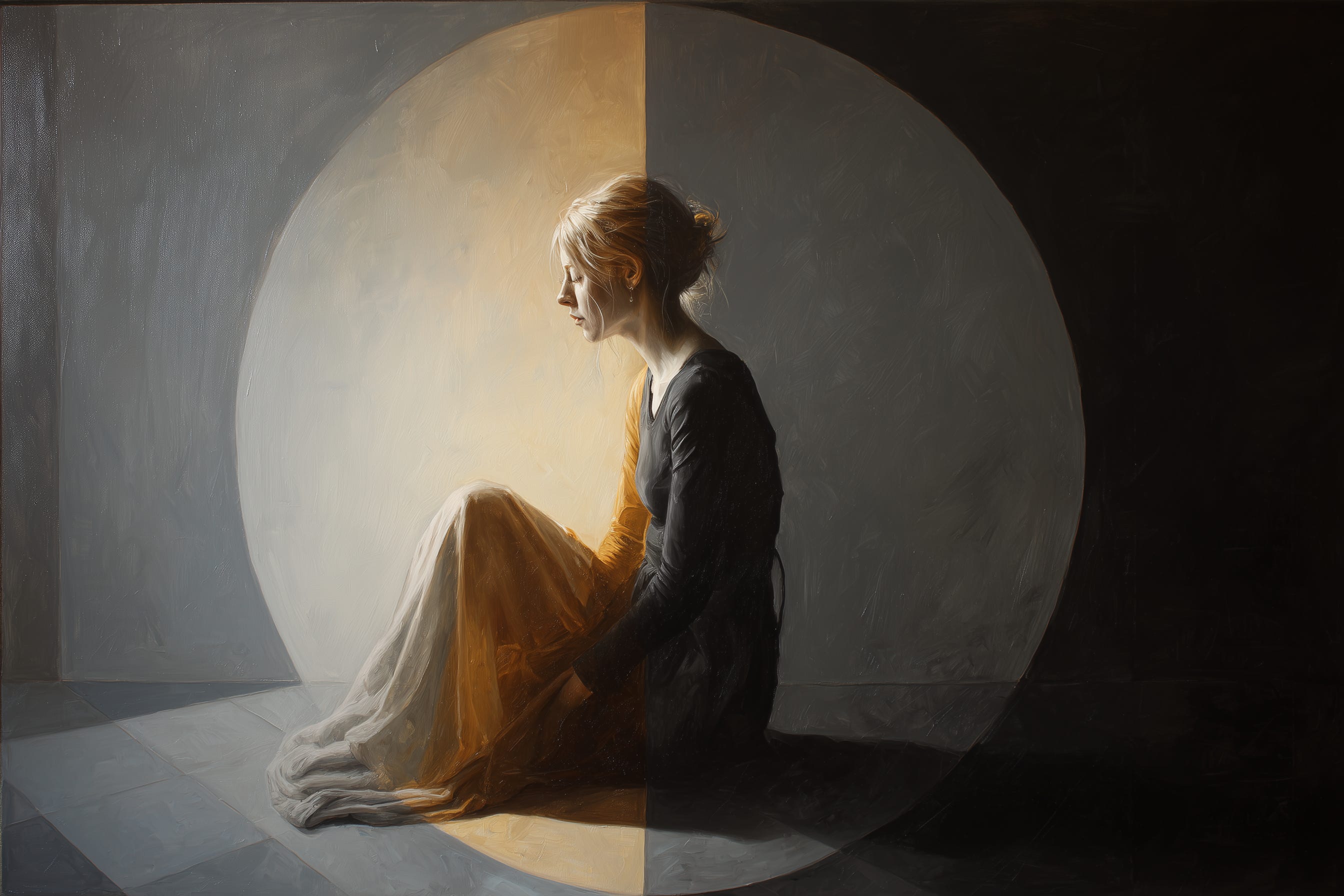
Being in the Valley of Tears is not a pleasant experience. Hours and hours sitting in a corner as I lose all expendable fluids and salts leaves the face in quite the state: puffy and sore. What caused this trip into this lonesome valley? Truth.
In my experience, truth is too often treated as something negotiable, as though it can be bartered into a middle that keeps everyone comfortable. A very stupid man once said, “The truth is always somewhere in the middle.” When this sentence first hits the ears it sounds reasonable, even wise. In practice, however, it is insidious. That ‘middle’ is not balance, but a void: a vague no-man’s-land where no one is truly seen or accountable, and deception can take root under the guise of compromise. It is a counterfeit harmony, a distortion of the true balance that only emerges when inner and outer realities are allowed to meet as they are.
After initially buying into this ‘philosophy,’ I was confronted with some very real absolutes. There are many situations where truth is not a matter of perspective, where harm is clear, and no compromise can erase it. Infidelity, for instance, is not half-trust and half-betrayal; it is broken trust. Child abuse is not partly justified and partly condemnable; it is violation, full stop. To suggest that the truth lies ‘somewhere in the middle’ of such realities is not wisdom but distortion.
Ultimately, this so-called middle is not truth at all. Rather it is a bargaining table, where versions of reality are traded until everyone feels somewhat satisfied and off the hook. Yet, without fully realising it, I used the very same logic in my own life, softening reality into a middle ground that excused me from responsibility.
I could sense what I was doing, but not clearly enough to name it. By conceding to a distorted version of events, I could sidestep my own accountability while allowing the other side to do the same. It was a subtle form of collusion, a way of protecting myself from conflict while reinforcing the very patterns that harmed me. The result was not harmony but non-reality; a false middle ground that, over time, eroded both trust in others and trust in myself.
Avoiding truth, in part, avoids accountability for who we are, what we feel, how we live, and the promises we keep or break. However, truth is not simply a fact to be agreed upon; it serves as both anchor and mirror for our experiences. As an anchor, it steadies us against the drift of wishful thinking. As a mirror, it reflects us back to ourselves, showing us what is real whether we welcome it or not. In this way, truth is not a judge but a guide. It points us toward the true path of least resistance: not avoidance or denial, but the natural flow that arises when life inside us and life outside us move in balance.
resisting what is within, resisting what is without
What results is truth yin and yang: two forces, distinct yet inseparable, circling one another to form a whole. Like the inhale and exhale of breath, inner truth and outer truth find their harmony when each is allowed to move in its own integrity. But when this rhythm is broken, something tears. A fracture opens in the fabric of reality and from that wound flows suffering. To resist the rhythm of yin and yang, the living current between inner and outer, is to reject reality itself. We may silence our inner life, choking what we feel; or distort the outer world, twisting it into something safer; or, as I did, deny both. To survive, I tried to bend both worlds into something tolerable, hiding my inner truth and reshaping outer truth until neither resembled reality at all.
Although I believed my inner self to be beautiful, I quickly concluded it was not safe to show. So I locked it away and reshaped it to suit the environment. The world around me felt too dangerous to face unguarded, so I learned to manage it, bending myself here, controlling circumstances there, doing whatever I could to make it feel less threatening. When change was impossible, I relied on softer defences: denial, reinterpretation, and manipulation disguised as care. I wasn’t trying to deceive; I was trying to survive. I built a bubble where the world was either shut out or softened, and behind those rose-coloured glasses, reality looked safer than it really was.
I fashioned a false middle, a fragile seam where inner truth and outer truth could be stitched together into a fabric of imagined safety. At times I redrew the world myself, painting over its edges until it looked softer. At other times I let others hand me their versions of reality and wore them as if they were my own. But this fabric never held. Reality shifted and shimmered like a mirage, always dissolving the moment I reached for it. What I called safety was only illusion, and what I called harmony was a mask. Beneath it, nothing was truly secure.
a polished doppelgänger masquerading as me
My greatest problem, however, was not that I had built this truth-bending defence, but that I began to believe in it. My system bought into the narratives I had constructed, until the illusion became indistinguishable from reality. At some point my soul was quietly pushed from the driver’s seat, and in its place sat the defence itself, steering my life with the cold precision of a mechanism that had forgotten what it was protecting. In time, it began to believe it was the very soul itself.
Because the copy was convincing, I let it stand in my place. I built walls of my own design; steel for strength, glass for show. From the outside, it looked as if I were transparent, open, available. However, what people saw was not the entirety of me, only a carefully managed reflection. It was a version of myself I permitted them to see, stripped of anything that felt dangerous or vulnerable. Every other expression was vetoed, locked away to prevent attack or damage from the outside. A two-way mirror: I could watch them, while they gazed at what they thought was me, never realising my true self remained hidden in the dark behind the glass.
This illusion was remarkably effective. It allowed me to appear open and vulnerable while, in truth, very little of my real self was ever on display. I could pour out love and care, I could be the attentive listener, steady guide, the one who was always there for others, all without ever risking my own exposure. People responded warmly to this and felt close, even held by me, and it was genuine. However, the flow of care moved only in one direction. Not because others refused to meet me, but because the gatekeeper inside me never allowed their care to reach beyond the glass.
At first, this gatekeeper played the part of a guardian, a ringmaster keeping the show controlled, keeping me safe. Over time, the role corrupted. The guardian became a tyrant, vetoing anything that carried risk, silencing every unapproved expression. What began as protection became imprisonment and so the very mechanism designed to shield me from harm kept me from the one thing I most longed for: to be seen, and to be loved as I truly was.
For a time, this strategy seemed to work. I could give love without risking exposure, guide others without ever being guided myself. It made me effective as a coach, but unreliable as a friend and distant as a partner. My fear of being truly seen was so deep that I even lied about my inner state to those I loved most; not to deceive, but to survive. In my history, revealing vulnerability had meant handing someone a weapon, and I refused to do that again.
Eventually, the mask became too convincing, it was no longer just something I wore but something others came to know as me. They trusted the performance, responded to it, even loved it. In their eyes, the illusion gained its own reality. The truth was, the mask could receive praise but never love, recognition but never intimacy, and because I lived behind it for so long, I too began to confuse the performance with the person. I mistook the appearance of closeness for closeness itself, until one day I could no longer tell the difference.
The cost of living behind a mask was that I stopped measuring life against my soul. I let the doppelgänger negotiate reality for me, and for a time it worked: I looked steady, devoted, tireless. However, the further I drifted from what was real, the more vulnerable I became to deception. Eventually the stage I had built for safety became the very trap that would undo me.
The dream was seductive: a community of seekers, bound by vision and spiritual work.
Years ago, I lived and worked in a healing centre. I gave everything; seven days a week, nearly no pay, ceremonies guided, articles written, a house managed, a vision tended. I poured myself into the promise that one day we would build paradise together.
But the promises never materialised. When I finally asked the obvious questions about finances and when this vision would be realised, I was not met with answers but with violence. One of the owners sexually assaulted me, and when I challenged him and his business practices, I was discarded like a liability.
I expected, at least, that those I had lived and served with for years would stand beside me. But when the time came, they did not. They admitted I had not been unreasonable and yet they turned away, because of convenience. That was the truth of it.
The shock of betrayal was unbearable. Losing the life I had built was grief enough; but the deeper wound was the collapse of the illusion I had lived inside. The intimacy I thought I had cultivated had never been real. If those bonds had been genuine, the outcome could have been different. I was forced to face a devastating truth: the closeness I believed in was not stolen from me, it had never existed.
At first, I fought the collapse with everything I had. I raged and defended myself: I was open, I was honest, I had given everything, and they had taken advantage. I clung to this story because the alternative, that I had been complicit in my own illusions, felt unbearable.
My partner, however, was the one person who refused to collude with me and he called my bluff. He named what I could not yet face: that I had been lying, not only to others, but to myself. It was not malice, but desperation, a survival instinct that had driven me to construct a persona that looked like vulnerability without ever exposing the real thing.
That was the turning point. I saw that my hunger for connection had been so great that I had convinced myself the performance was enough. To admit this was agony, but it was also the first crack in the mask. For the first time, I began to understand that survival had demanded a lie and that the lie had cost me the very life I longed for.
The hardest part was recognising that this was not only the result of others’ abuse. It was also the abuse I had enacted against myself. My refusal to acknowledge what was truly happening within me, the constant erasure and redirection of my own feelings, had become a form of self-betrayal so complete it ran on autopilot. That was a painful wakeup call, to see that the wound was not only inflicted from outside, but sustained from within.
Out of this realisation came two truths I could not escape. First, if I ever wanted to heal, I would have to reveal what was inside, first to myself, and then tremblingly to others. Second, I would have to face how my own defences, once built to protect me, had turned cruel and punishing, and that their first victim was always me.
This was the true beginning of healing. Not utopian fantasies nor walls of illusion but the terrifyingly simple questions: How do I feel? What is real inside me? What is real outside me? And can I bear to express it?
The first attempts were excruciating. My partner, patient though he was, had to endure my faltering efforts. Sometimes I sat beside him, rigid with discomfort, unable to name what moved inside me. He would cry out in frustration, “I’m here! I’m right here for you!” Only then, when I reached for a hug, would the torment break, and inner and outer reality would finally touch.
In that moment I discovered something that transformed the entire landscape. The truth I had been hiding from was not grand or complex but disarmingly simple: I was sad, I needed love, and for the first time it was safe to receive it. Sorrow within, met by care without. Yet for me, even that truth felt impossible. My system had learned to erase it before it could rise to the surface. It did not trust that my truth however small, would be met with care rather than attack.
That is the battlefield I live on. Between the truths that struggle to emerge and the reflex that denies them; between the need to be seen and the terror of exposure. However, step by step, I am learning. Step by step, I am teaching myself that truth, inner and outer, however small, is not only survivable, it is crucial.
My inner battlefield is only a mirror of a larger lie we are all tempted to live. This lie asserts truth is something that can be negotiated and bartered into some safe ‘middle’ where no one is accountable. However, yin and yang are not a blurred compromise; they are two distinct realities held in tension, each complete in itself, each making the other whole. True balance is not found by diluting what is real, but by letting the inner and outer truths stand as they are and allowing their meeting point to create harmony.
I see now that a lot of my pain came not from truth itself, but from resisting it. From splitting off my inner reality and twisting the outer to suit my fears. The ‘middle’ I built was not balance but distortion, a refuge for denial. Real balance begins only when I stop bargaining with reality and start allowing both sides of truth to exist, accepted and unedited.
Healing lives not in compromise nor in illusion, but in the meeting of truths. When I can bear what is within me and what is around me, without twisting either, I return to the path that was always there, the path where inner and outer are not enemies but partners. That, I am learning, is the true middle: not the vague nowhere of avoidance, but the living union of what is real.
Elsewhere in The Province of the Mind:

Fire Returned to Heaven

This is the introduction to my ongoing series Fire Returned to Heaven: Transcripts from solitary prayer walks recorded over the past years. Each walk was spoken aloud, later transcribed and gently edited for clarity and privacy.
Amazing self reflection and honest so complex I will have to read and read again. Inspiring!